Absolute Business Continuity When Lives Are on the Line.
Hospitals cannot afford the 'minutes to hours' response times of traditional EDR. Cyber Crucible intercepts threats autonomously in under 200 milliseconds, ensuring critical medical operations never stop.
The 'Selective Freeze' Advantage.
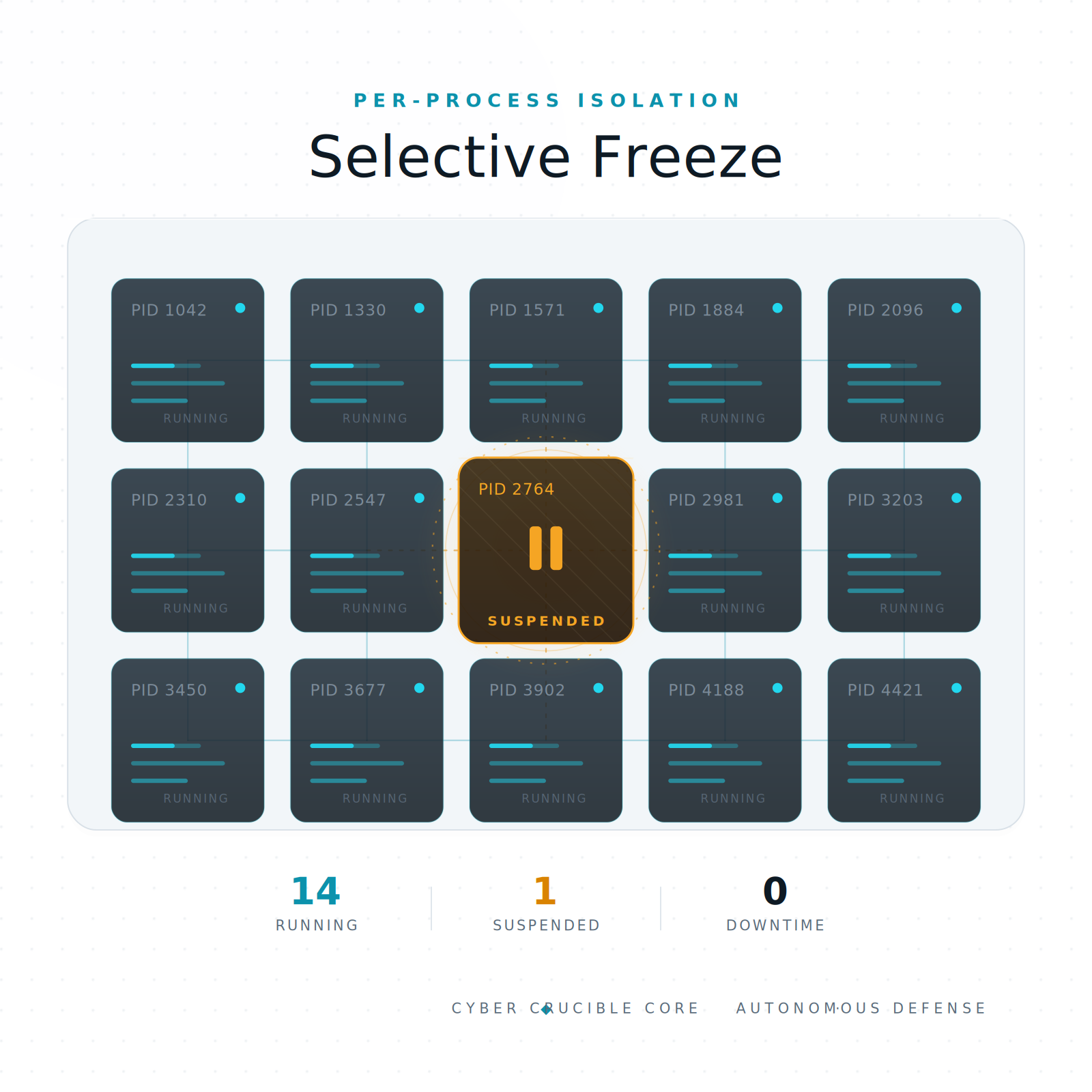
When XDR tools detect an anomaly, they often require a full system lockdown. Cyber Crucible's Smart Containment performs a 'Selective Freeze' on the malicious process only.

Keep Patient Data on the Endpoint.
Vendor-hosted SOCs often require uploading highly sensitive keys or files to third-party cloud databases, creating massive HIPAA and compliance risks.
Never Reboot a Ventilator's Network.
From the ICU to connected medical devices, the same autonomous agent neutralizes threats without lockdowns, downtime, or a single interrupted procedure.
See how the platform worksProtect Patient Care, Without Compromise.
See threats neutralized in under 200ms — with zero downtime to clinical operations.
Frequently asked questions
How does Cyber Crucible avoid downtime for clinical operations?
Its Smart Containment performs a 'Selective Freeze' on the malicious process only, suspending the attack in memory in under 200ms. Medical operations and connected devices keep running with zero downtime and no system reboot.
Does it keep patient data HIPAA-compliant and on the endpoint?
Yes. Analysis happens locally at the kernel level and sensitive assets never leave the endpoint, avoiding the HIPAA and compliance risks of uploading keys or files to third-party cloud SOCs — true data sovereignty.